



Gene K. Lee, MD, MPH
Genioplasty & Chin Augmentation in Beverly Hills, CA
The chin occupies a relatively small part of the face, but its projection, width, height, and relationship to the nose and jawline can significantly influence overall facial balance. A chin that sits too far back may make the nose appear more prominent, soften the transition into the neck, or leave the lower face looking less defined even when the surrounding features are otherwise well proportioned.
Genioplasty, also known as chin augmentation or chin surgery, reshapes or repositions the chin to create better harmony throughout the face. Depending on your anatomy and goals, Dr. Lee may augment the chin using a biocompatible implant or reposition the patient’s own chin bone with a sliding genioplasty.
At LA MÔEM Plastic Surgery in Beverly Hills, board-certified plastic and reconstructive surgeon Gene K. Lee, MD, MPH, approaches chin augmentation as part of the complete facial profile rather than an isolated feature. He considers the nose, lips, jawline, neck, cheekbones, and facial proportions when determining how much change will create a natural, balanced result.
Continue reading to learn more about genioplasty and chin augmentation in Beverly Hills with Dr. Gene K. Lee, or contact us online today to schedule your consultation. We are located in Beverly Hills and proudly welcome patients from the Inland Empire, San Fernando Valley, Downtown Los Angeles, Pasadena, and the greater Los Angeles area.
Quick Links
- How Does Chin Augmentation Affect the Appearance of the Nose?
- Genioplasty vs. Chin Filler: Which Is Right for Me?
- Can Genioplasty Be Combined with Other Facial Procedures?
- Why Choose Dr. Gene K. Lee for Genioplasty in Beverly Hills, CA?
- What to Expect During Your Genioplasty Consultation
- What Is Recovery Like After Genioplasty?
- When Will I See My Genioplasty Results?
- FAQs
What Is Genioplasty?
Genioplasty is surgery performed to change the size, shape, projection, or position of the chin.
Although the term is commonly associated with increasing the projection of a small or recessed chin, genioplasty is broader than simple augmentation. Depending on the technique, the chin can be moved forward, backward, vertically, or toward one side to improve facial symmetry and proportion.
There are two primary approaches to surgical chin augmentation:
- Chin implant surgery adds a biocompatible implant over the existing chin bone to increase projection and definition.
- Sliding genioplasty, also called osseous genioplasty, surgically repositions a portion of the patient’s own chin bone.
Both can create greater chin projection, but they accomplish that change differently. The correct choice depends on more than how “weak” the chin appears from the side. Dr. Lee evaluates the three-dimensional shape of the lower face, including:
- Chin projection
- Chin height and width
- Facial symmetry
- Jawline definition
- Nose-to-chin relationship
- Lip position
- Neck contour
- Dental and jaw alignment
- Overall facial proportions
What Can Chin Augmentation Improve?
Chin surgery can create a meaningful change in facial balance even when the amount of physical movement is relatively small.
Genioplasty may help improve:
- A small or recessed chin
- Limited chin projection
- A chin that appears disproportionate to the nose
- Poor definition between the lower face and neck
- An uneven or asymmetric chin
- A chin that sits too far forward
- A chin that is too long or too short
- Lower facial proportions that feel unbalanced
- Jawline definition affected by limited chin projection
- Certain structural concerns following trauma or previous surgery

A recessed chin can be particularly noticeable in profile.
When the chin sits farther back than the lips and other facial structures, the nose may appear larger, the jawline may look less defined, and the transition between the chin and neck can appear softer.
Augmenting the chin can change these relationships without altering the surrounding features themselves. This is why Dr. Lee evaluates chin surgery as a facial balancing procedure, not simply a way to add projection.
Who Is a Good Candidate for Genioplasty?
You may be a candidate for chin augmentation if you are bothered by the size, projection, shape, or position of your chin and would like a structural, long-lasting change.
Good candidates are generally:
- In good overall health
- At a stable weight
- Non-smokers or willing to stop nicotine use as directed
- Skeletally mature
- Bothered by a recessed, small, asymmetric, or disproportionate chin
- Realistic about what chin surgery can accomplish
- Interested in improving facial balance rather than pursuing an exaggerated facial shape
Jaw and dental alignment are also important. An isolated genioplasty changes the chin, but it does not reposition the entire upper or lower jaw or correct every type of bite problem.
If a significantly recessed lower jaw, malocclusion, or broader skeletal abnormality is contributing to your facial proportions, Dr. Lee may recommend additional evaluation rather than treating the chin alone.
The consultation is designed to distinguish between a chin-position problem and a more comprehensive jaw-position problem.
What Is a Sliding Genioplasty?
A sliding genioplasty changes the chin by repositioning the patient’s own bone.
During surgery, Dr. Lee makes an incision inside the lower lip and accesses the chin bone. A carefully planned cut, known as an osteotomy, is made through the lower portion of the chin.
The separated segment of bone can then be repositioned. Depending on the patient’s anatomy, sliding genioplasty can move the chin:
• Forward to improve projection
• Backward when excessive projection is present
• Vertically to lengthen or shorten the chin
• Sideways to improve certain asymmetries
Because the patient’s existing bone is being repositioned, sliding genioplasty offers flexibility that extends beyond simply adding volume to the front of the chin.
For patients with specific structural concerns involving chin height, asymmetry, or position in more than one dimension, this can be an important advantage.
The incision is generally placed inside the mouth, so there is no visible external scar from the access point.
What Is Chin Implant Surgery?
Chin implant surgery augments the existing chin using a biocompatible implant placed directly over the bone.
Rather than cutting and repositioning the chin itself, Dr. Lee creates a precise pocket and places an implant selected to complement the patient’s anatomy. The implant can add projection and improve definition through the lower face.
Chin implants are available in different sizes and shapes, allowing the degree and distribution of augmentation to be customized.
The incision may be placed inside the mouth or discreetly beneath the chin depending on the surgical approach and individual patient considerations.
Implant-based augmentation can be particularly useful when the primary concern is insufficient projection and the patient’s existing chin shape and vertical proportions are otherwise appropriate. As with any facial implant, careful sizing and positioning are essential.
An implant that is too large can dominate the lower face rather than balancing it. Dr. Lee selects the amount of augmentation by considering how the chin relates to the lips, nose, jawline, and neck rather than treating projection as an isolated measurement.
Sliding Genioplasty vs. Chin Implant: What Is the Difference?
Both procedures can enhance a small or recessed chin, but the underlying approach is fundamentally different.
Sliding Genioplasty
Sliding genioplasty uses your own chin bone. The bone is surgically repositioned and secured in its new location. Because the chin itself is moved, the procedure can address certain concerns involving horizontal projection, vertical height, and asymmetry.
Chin Implant
A chin implant adds a biocompatible material over the existing bone.
The underlying chin remains in place, while the implant increases projection and alters contour. Neither technique is universally better.
A patient who primarily needs straightforward forward projection may be well suited to an implant. Someone whose chin requires movement in multiple dimensions may benefit from a sliding genioplasty.
Other considerations include:
- Existing bone structure
- Degree of augmentation needed
- Chin height
- Facial asymmetry
- Jaw and bite relationship
- Desired contour
- Preference regarding an implant
- Previous facial surgery
Dr. Lee will explain which technique provides the most appropriate control for your individual anatomy.
Can Chin Augmentation Improve the Jawline?
Yes, when limited chin projection is contributing to poor lower facial definition. The chin forms the central endpoint of the jawline. When it is recessed, the lower face may appear shorter or less defined and the jawline may seem to fade as it approaches the center of the face.
Increasing chin projection can extend this contour forward and create a stronger transition between the jaw, chin, and neck. However, chin augmentation does not physically reshape the entire jaw. If jawline softness is primarily caused by fat beneath the chin, Dr. Lee may discuss submental liposuction. If loose skin, jowling, or deeper tissue descent is the primary issue, a neck lift or facelift may address the anatomy more directly.
Some patients have more than one contributing factor. A recessed chin combined with submental fullness, for example, can make the chin-neck angle appear considerably softer than either condition alone.
Dr. Lee evaluates each component before determining whether genioplasty should be performed by itself or as part of a broader facial-contouring plan.
How Does Chin Augmentation Affect the Appearance of the Nose?
The nose and chin have a particularly important relationship in profile. A chin that sits too far back can make the nose appear more projected or prominent than it actually is. Increasing chin projection can bring the lower face forward and create better balance between the two features.
Importantly, the nose has not changed. Its appearance changes in relationship to the newly balanced chin. This is one reason Dr. Lee assesses chin projection when evaluating patients for rhinoplasty. A patient may initially focus almost entirely on the nose when limited chin projection is also contributing significantly to the profile.
Some patients ultimately need rhinoplasty alone. Others may benefit from chin augmentation alone, and selected patients may choose to address both during the same surgical plan.
Genioplasty vs. Chin Filler: Which Is Right for Me?
Not every patient who wants a stronger chin needs surgery. Dermal fillers can add temporary volume to the chin and may improve projection, shape, or contour without an operation.
Chin filler may be appealing for patients who:
- Want a modest change
- Prefer a non-surgical treatment
- Are not ready for permanent structural augmentation
- Want to see how additional chin projection affects facial balance
- Have anatomy that can be effectively addressed with injectable volume
Surgical genioplasty provides a different degree of structural correction. A sliding genioplasty physically repositions bone, while a chin implant provides durable augmentation using a surgically placed implant. Neither requires the repeated maintenance associated with temporary injectable filler.
The degree of projection also matters. Trying to create substantial skeletal augmentation using large amounts of filler may not be the most elegant or appropriate solution for every patient.
Dr. Lee can help you determine whether your goals are best addressed through temporary injectable contouring or permanent surgical change.
Can Genioplasty Be Combined with Other Facial Procedures?
Yes. Since chin position affects the balance of the entire profile, genioplasty is commonly considered alongside other facial-contouring or rejuvenation procedures.
Depending on your anatomy and goals, Dr. Lee may discuss combining chin augmentation with:
Why Choose Dr. Gene K. Lee for Genioplasty in Beverly Hills, CA?
Successful chin augmentation requires an understanding of more than the chin itself. The result has to work with the nose, lips, cheeks, jawline, neck, facial width, and the natural characteristics that make each patient’s face distinct.
Dr. Gene K. Lee is a board-certified plastic and reconstructive surgeon whose facial practice includes rhinoplasty, facelift, facial fat grafting, facial feminization, submental contouring, and other procedures that require detailed analysis of facial proportions.
His current facial surgery offerings include genioplasty using either a biocompatible implant or surgical bone repositioning, allowing the technique to be selected according to the patient’s anatomy rather than limiting every chin augmentation to a single approach.
Dr. Lee’s philosophy emphasizes balance and preservation of individual identity. For chin augmentation, this means resisting the assumption that stronger is always better.
A chin that projects too far or becomes disproportionately wide can alter the face just as much as a recessed chin can. Dr. Lee carefully evaluates frontal, profile, and three-quarter proportions to determine how much correction creates harmony without allowing the chin to dominate surrounding features.
Patients are also given time to understand why a particular technique is recommended and what realistic changes can be expected.
What to Expect During Your Genioplasty Consultation
Your consultation begins with a discussion of what you notice about your chin and lower face.
Dr. Lee may ask:
- Whether you have always been bothered by your chin
- Whether your primary concern is projection, width, height, or asymmetry
- Whether the concern is more noticeable from the front or profile
- Whether you are also considering rhinoplasty or another facial procedure
- Whether you have undergone previous facial or jaw surgery
- Whether you have concerns about your bite or dental alignment
- Your medical history
- Current medications
- Smoking or nicotine use
- What type of change you hope to achieve
Dr. Lee will then examine your face from multiple angles.
He will assess:
- Chin projection
- Chin width and height
- Facial symmetry
- Jaw position
- Dental relationship when relevant
- Nose projection
- Lip-to-chin relationship
- Jawline definition
- Neck contour
- Overall facial proportions
Photographs may be taken for surgical planning. Depending on the technique being considered, imaging may also be useful to evaluate the underlying bone and plan the degree and direction of skeletal movement.
Dr. Lee will then explain whether an implant, sliding genioplasty, non-surgical augmentation, or another approach makes the most sense for your anatomy.
What Is Recovery Like After Genioplasty?
Recovery depends partly on whether you undergo sliding genioplasty or chin implant surgery. Swelling, bruising, tightness, tenderness, and temporary changes in sensation around the chin and lower lip can occur with either technique.
If the incision is placed inside the mouth, Dr. Lee will provide specific oral-care instructions. Patients may need to use a prescribed or recommended mouth rinse and temporarily follow a soft-food diet while the incision begins healing. A supportive dressing may also be placed around the chin during early recovery.
Patients should generally expect to:
- Keep the head elevated to help reduce swelling
- Use cold compresses as directed
- Follow oral or incision-care instructions carefully
- Avoid strenuous exercise during early healing
- Avoid pressure or trauma to the chin
- Eat softer foods when an intraoral incision is used
- Avoid smoking and nicotine
- Attend all scheduled follow-up appointments
Much of the initial bruising and swelling improves during the first couple of weeks, although the chin can remain swollen longer.
Patients with non-strenuous jobs may return to work relatively early depending on their comfort and appearance, while strenuous activity requires a more gradual return.
Sliding genioplasty also requires the repositioned bone to heal securely, so postoperative restrictions are important even after you begin feeling more normal.
When Will I See My Genioplasty Results?
The difference in chin projection is visible immediately after surgery, but swelling initially obscures the final shape. As the swelling decreases over the following weeks, the relationship between the chin, nose, lips, jawline, and neck becomes progressively clearer.
More subtle swelling can persist for several months. With sliding genioplasty, the repositioned bone also needs time to heal in its new position. Patients should therefore avoid judging the final result too early.
The ultimate goal is a chin that does not immediately announce that surgery was performed. Ideally, the lower face simply appears more proportionate, with improved profile balance and a stronger relationship between the chin and surrounding features.
Schedule Your Beverly Hills Genioplasty with Dr. Gene K. Lee
At LA MÔEM Plastic Surgery, Dr. Gene K. Lee evaluates the chin as one component of complete facial harmony. Depending on your anatomy, genioplasty may involve a biocompatible chin implant, surgical repositioning of your own chin bone, or consideration of a non-surgical alternative.
To schedule your genioplasty or chin augmentation consultation in Beverly Hills, call LA MÔEM Plastic Surgery at (310) 919-0777 or complete our online contact form.
We proudly welcome patients from Beverly Hills, Los Angeles, Pasadena, Downtown Los Angeles, the San Fernando Valley, the Inland Empire, and surrounding communities.
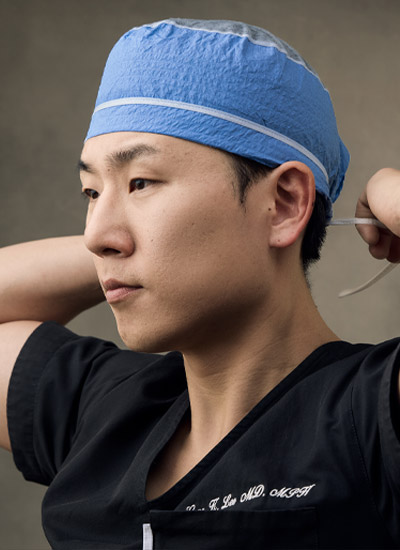
Meet Gene K. Lee MD, MPH, FACS
Board-Certified Plastic Surgeon
At LA MÔEM Plastic Surgery, Dr. Gene K. Lee combines advanced surgical training with a thoughtful, ethical approach to aesthetic care. Known for his natural-looking results and deep respect for each patient’s unique goals and cultural identity, Dr. Lee creates personalized treatment plans focused on safety, integrity, and long-term satisfaction. When you choose Dr. Lee, you’re choosing a surgeon who values your trust and is dedicated to helping you look and feel your best—authentically.







Los Angeles Genioplasty FAQs
Is genioplasty the same as chin augmentation?
Genioplasty is a broad term for surgery that reshapes or repositions the chin. Chin augmentation specifically refers to increasing chin projection or size. Augmentation can be performed with an implant or by repositioning the patient’s own chin bone.
Is a sliding genioplasty better than a chin implant?
Neither is universally better. Sliding genioplasty allows the surgeon to reposition the patient’s own bone in multiple directions, while an implant can provide straightforward augmentation without cutting and moving the chin bone. Dr. Lee recommends the technique that best fits the patient’s anatomy and goals.
Is genioplasty the same as jaw surgery?
No. Genioplasty changes the chin portion of the lower jaw but does not reposition the entire jaw. Orthognathic jaw surgery addresses broader skeletal and bite relationships. Patients with significant jaw misalignment may require additional evaluation rather than isolated genioplasty.
Can genioplasty fix a weak chin?
Yes. A recessed or underprojected chin is one of the most common reasons patients consider genioplasty. Depending on the anatomy, Dr. Lee may increase projection with an implant or move the chin bone forward.
Can genioplasty make the chin smaller?
Sliding genioplasty can be used for more than augmentation. Depending on the patient’s anatomy, the chin bone may be moved backward, shortened, or otherwise repositioned to improve proportion.
Can genioplasty correct chin asymmetry?
Certain forms of asymmetry can be improved by repositioning the chin bone or customizing augmentation. The degree of improvement depends on whether the asymmetry originates in the chin itself or involves the broader jaw and facial skeleton.
Will chin augmentation make my nose look smaller?
It does not physically change the nose, but improving a recessed chin can make the nose look more proportional in profile. The apparent size of facial features depends partly on how they relate to one another.
Can I combine genioplasty with rhinoplasty?
Yes. Chin augmentation and rhinoplasty may be considered together when both the nose and chin contribute to profile imbalance. In other patients, correcting one feature may provide enough improvement that less change is needed elsewhere.
Can chin augmentation improve a double chin?
Improving chin projection can create a stronger chin-to-neck relationship, but it does not remove excess fat. Patients with both a recessed chin and submental fullness may benefit from combining genioplasty with submental liposuction when appropriate.
Does genioplasty leave a visible scar?
Sliding genioplasty is commonly performed through an incision inside the mouth, leaving no visible external incision. Chin implants may be placed through an intraoral incision or an incision discreetly positioned beneath the chin depending on the approach.
Is genioplasty painful?
Anesthesia keeps patients comfortable during surgery. Swelling, pressure, soreness, and tightness are expected afterward, but Dr. Lee will provide instructions and appropriate medication for managing discomfort during recovery.
Will my lower lip or chin feel numb after genioplasty?
Temporary numbness, tingling, or altered sensation can occur because nerves supplying the lower lip and chin are located near the surgical area. Sensation often improves during healing, although persistent changes are a potential surgical risk.
How long does swelling last after chin surgery?
The most noticeable swelling generally improves during the first several weeks, but subtle swelling may persist longer. Final facial proportions are better judged after the tissues have had several months to settle.
Are chin implant results permanent?
Chin implants are designed to provide long-term structural augmentation. However, implants can shift, become infected, or require revision in the future. Dr. Lee will discuss implant-specific risks before surgery.
Is sliding genioplasty permanent?
Once the repositioned chin bone heals in its new location, the structural change is intended to be long-lasting. The face will still undergo normal changes associated with aging.
Is filler a good way to test whether I would like chin augmentation?
For some patients, temporary dermal filler can provide a sense of how additional chin projection influences facial balance. However, filler does not precisely reproduce the structural change possible with an implant or sliding genioplasty, especially when substantial correction is required.